
Trending in 'Health'
Top Exercise Physiologist: "This Is How Sciatica Sufferers Can Work 8 Hours Without Constant Pain"
The overlooked 6-position method for desk workers who can't sit or stand for long — and why another expensive ergonomic chair may not be the answer.
1,843 Ratings
By Dr. Sophia Carters, PhD — Exercise Physiologist with 18 Years of Experience in Back Pain Management.
I'm about to say something that's going to piss off a lot of companies selling $1,000 ergonomic chairs to people with back pain.
Why are we telling people who can't sit for 30 minutes to buy a better chair?
I've heard people say they spend half their meetings trying not to move because they're embarrassed.
That they turn off their cameras just so they can stand up and stretch.
That they get home from work and go straight to bed because they can't take another minute of sitting.
And the worst one?
"I'm scared I'm going to lose my job."
These people have tried physical therapy.
Special cushions.
Expensive ergonomic chairs.
Standing desks.
And still, every morning, they're back at the same desk.
Waiting for that familiar burning pain to start creeping down their leg.
But here's what bothered me.
Almost everything they were buying was supposed to make sitting more comfortable.
What if staying in one position for too long was part of the problem?
And what if there was a way to get through an eight-hour workday without having to stay in any one position for eight hours?
But something I came across changed the way I thought about this entire problem.
And it started with a woman who was terrified she was about to lose her job.
The Woman Who Was Afraid of Losing Her Job
Rachel was 37.
A project manager.
She'd been dealing with sciatica for almost four years.
When she first described her symptoms, I could see how exhausted she was.
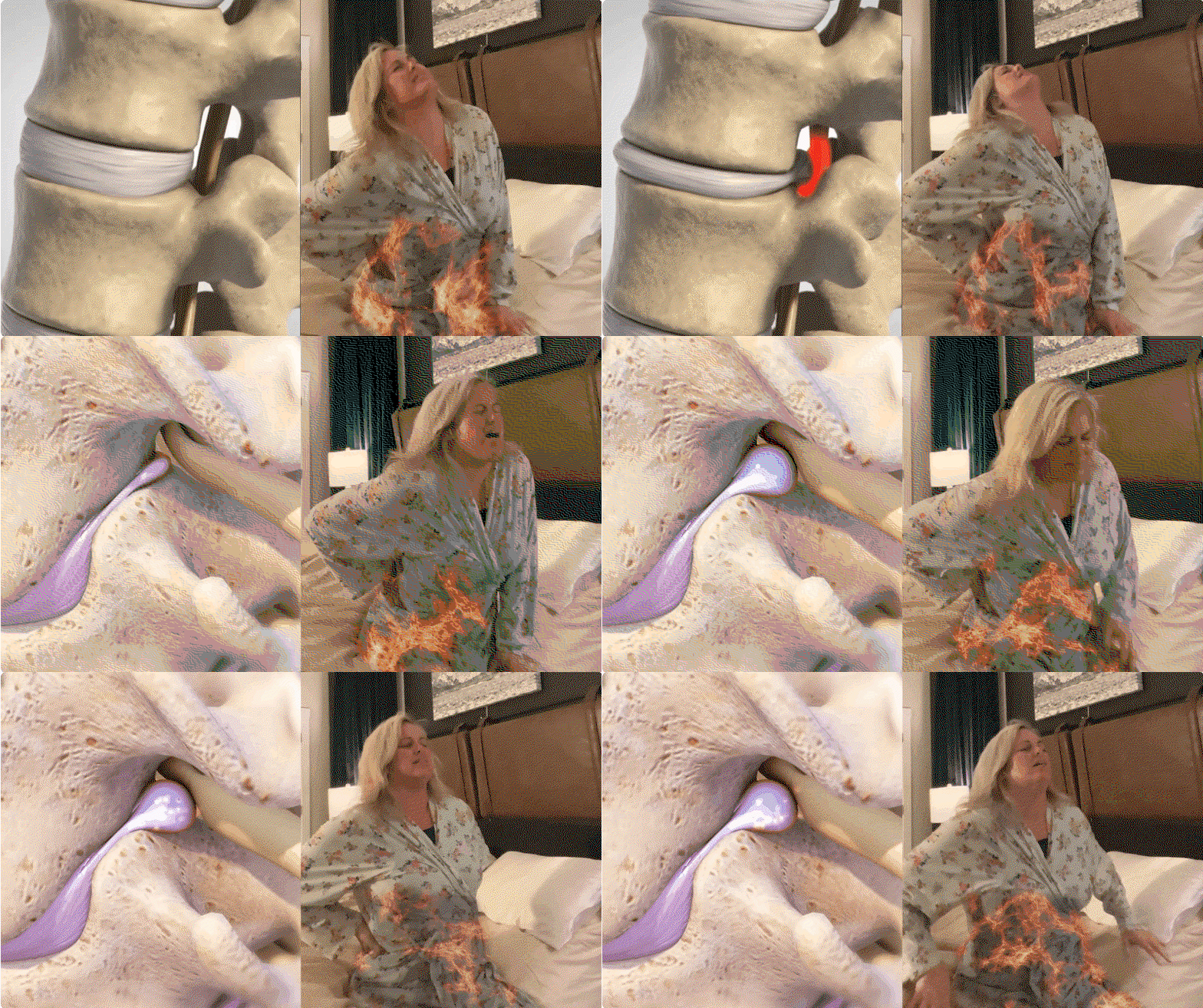
"Then it's like someone is dragging a hot wire through my butt and down my leg."
But the worst part wasn't even the pain itself.
It was that she couldn't escape it at work.
"Twenty minutes. That's about all I can sit before I have to get up."
She told me she'd started turning off her camera during Zoom meetings so nobody would see her standing, stretching, or leaning over her desk.
Sometimes she'd miss half the conversation because she was so focused on finding a position that didn't hurt.
Then something happened that really shook her.
Her manager called her into a meeting.
A project had fallen behind schedule.
She'd missed several important details during client calls.
"He asked me if everything was okay. If I could still handle the workload."
"And I didn't know what to say."
Because how do you explain that you're falling behind at work because sitting in a chair hurts?
"I used to be really good at my job," she told me.
"Now I can't even concentrate. I'm terrified they're going to think I can't do it anymore."
She'd already spent almost $900 on an ergonomic chair.
Bought a special sciatica cushion.
Done months of physical therapy.
Then she got a standing desk because everyone said sitting was the problem.
Except standing wasn't much better.
After a while, her legs got tired.
Her lower back started aching.
So she'd sit down.
And the burning would come right back.
"I can't sit. I can't stand all day. What the hell am I supposed to do?"
When she finished work, she didn't have the energy to do much of anything.
She'd shut her laptop.
Walk into her bedroom.
And lie down.
Her husband would ask if she wanted to go for a walk after dinner.
And most evenings, she'd say no.
Not because she didn't want to spend time with him.
Because she'd already spent eight hours fighting to get comfortable.
"I feel like I'm losing the person I used to be."
That one sentence hit me harder than anything she'd said about the pain.
Because this wasn't just about being uncomfortable at a desk.
She was starting to lose confidence in herself.
She was worried about her career.
Her marriage.
And whether she'd be able to keep doing the job she'd spent years building.
She'd even started asking her doctor about injections.
And reading about surgery.
Not because she wanted either.
Because she couldn't imagine doing this every day until retirement.
I remember leaving that conversation feeling frustrated.
Not with Rachel.
With how few practical answers I could give her about the eight hours she still had to spend working every day.
Her doctors were addressing the medical side of her sciatica.
But nobody had really answered the question she kept asking.
How am I supposed to do my job when I can't stay in one position long enough to get anything done?
And a few weeks later, I came across something that made me look at that question very differently.
The Discovery That Changed Everything
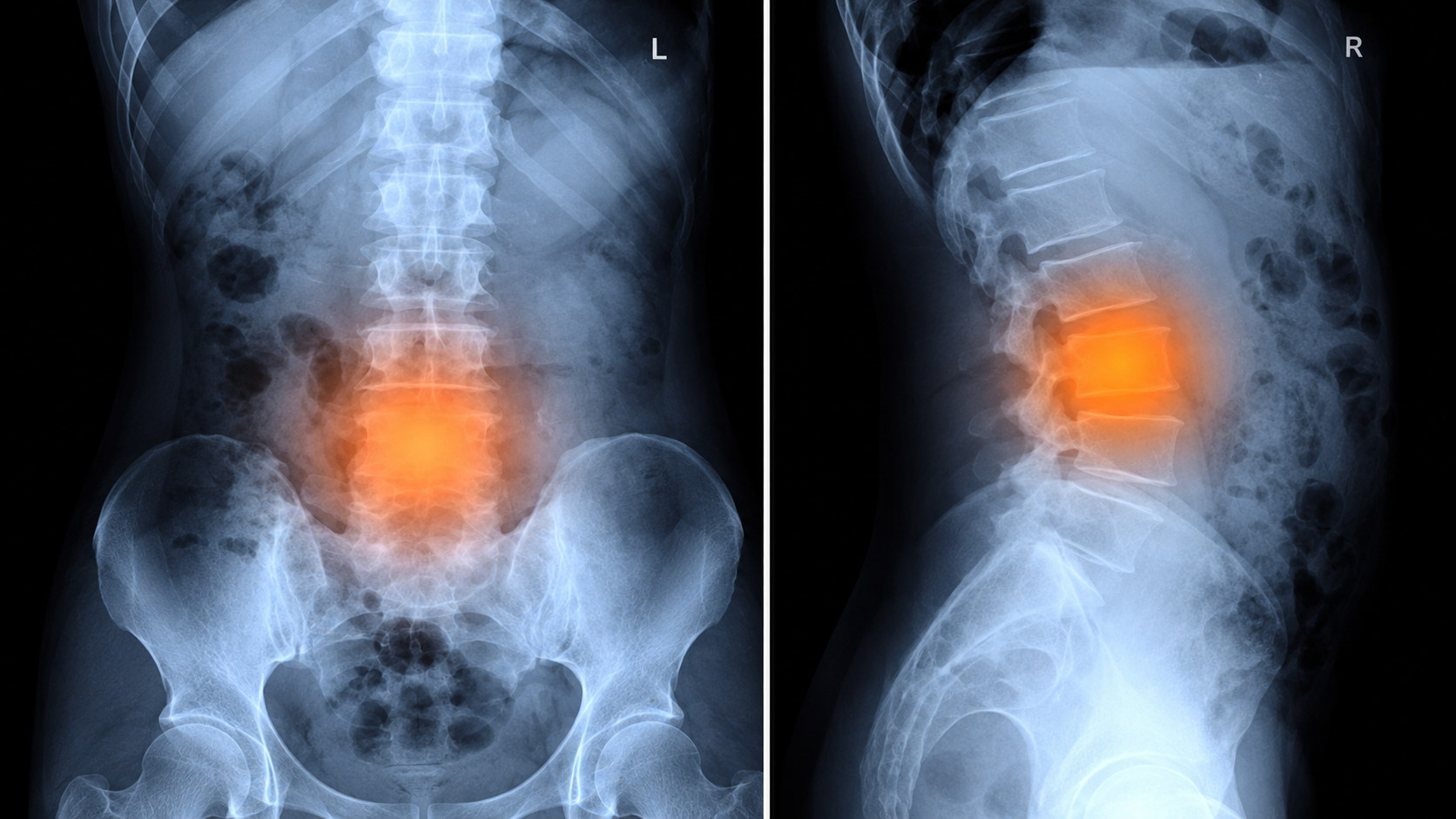
I was attending an ergonomics conference when one of the speakers started talking about something I'd never paid much attention to.
Postural variability.
Basically, what happens when your body is allowed to keep changing positions instead of staying in the same one for hours.
At first, it didn't sound particularly exciting.
Until he started explaining the effect of holding one position for too long.
When you sit for hours, your lower back, hips, and surrounding tissues remain under a similar pattern of mechanical loading.
For someone whose sciatica is sensitive to that position, symptoms can build as they stay there.
That's why some people feel okay when they first sit down.
Then twenty minutes later, they're desperately looking for a reason to get up.
But here's the interesting part.
Changing positions doesn't just mean standing up.
You can change your hip angle.
The position of your lower spine.
Which muscles are doing the work.
And how your body weight is supported.
The technical term is load redistribution.
In plain English?
Different positions put different demands on your body.
And depending on what's causing someone's sciatica, sitting or standing in certain positions can make symptoms worse.
That's why there isn't one perfect posture for everyone.
And that's when I thought about Rachel.
She wasn't someone who needed to be reminded to move.
She was already getting up, stretching, and trying to find relief throughout the day.
But every time she did, she lost focus on what she was supposed to be doing.
What if she could change how her body was supported without constantly interrupting her work?
That was the question I wanted to answer.
The 6-Position Movement Method
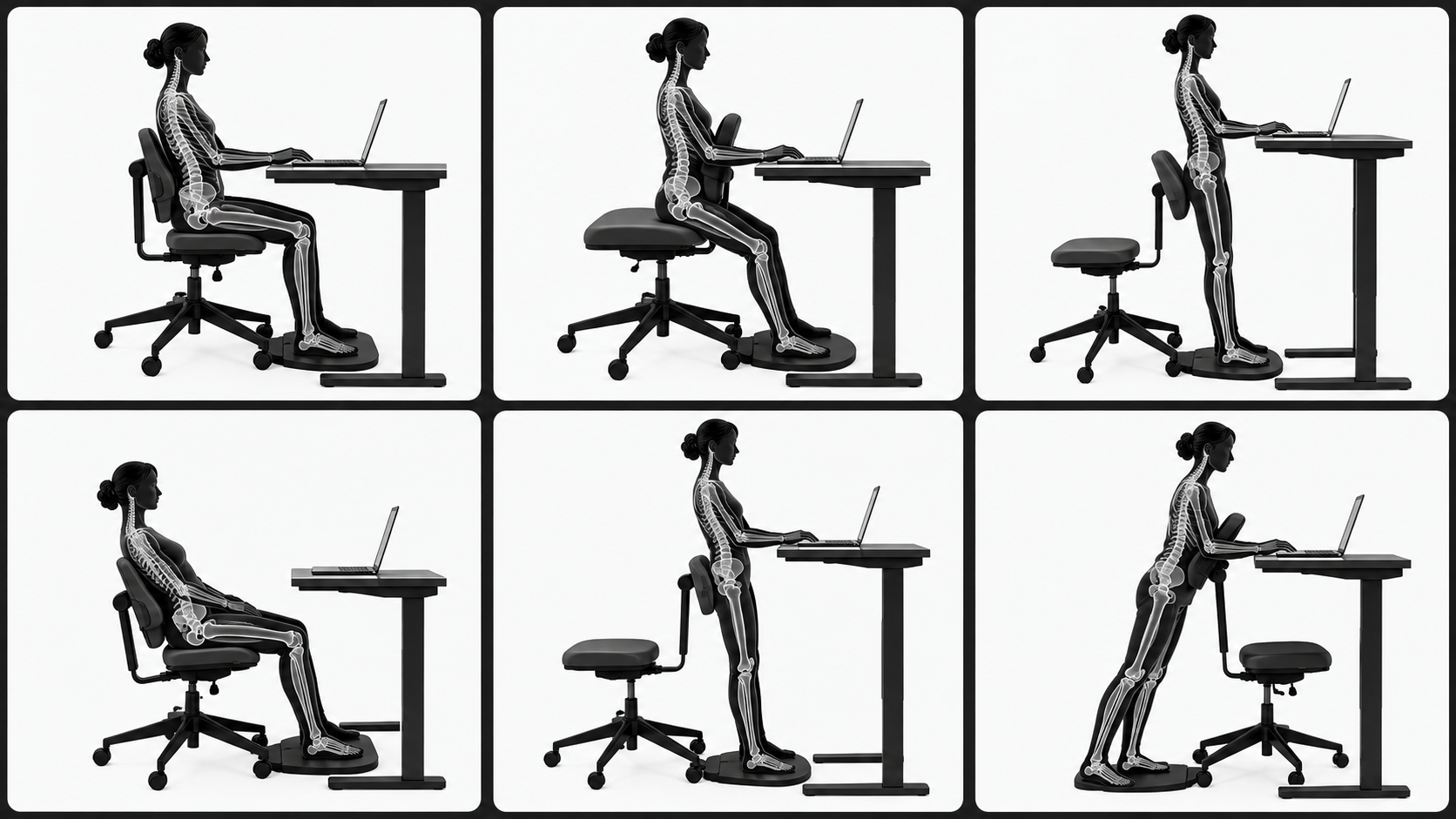
After that conference, I kept coming back to three simple principles.
CHANGE YOUR POSTURE
Moving between different supported positions changes the arrangement of your hips and lower back, instead of holding one posture for hours.
REDISTRIBUTE YOUR BODY WEIGHT
Different positions support different parts of your body, changing which muscles and structures carry the load.
KEEP WORKING WHILE YOU MOVE
You can change between supported positions without repeatedly getting up, leaving your workstation, or interrupting what you're doing.
Together, these principles became what I called the 6-Position Movement Method.
Change your posture. Redistribute the load. Keep working.
The idea made sense.
But I still hadn't found a workstation that could put it into practice.
5 Months Later, I Finally Found Something Worth Trying
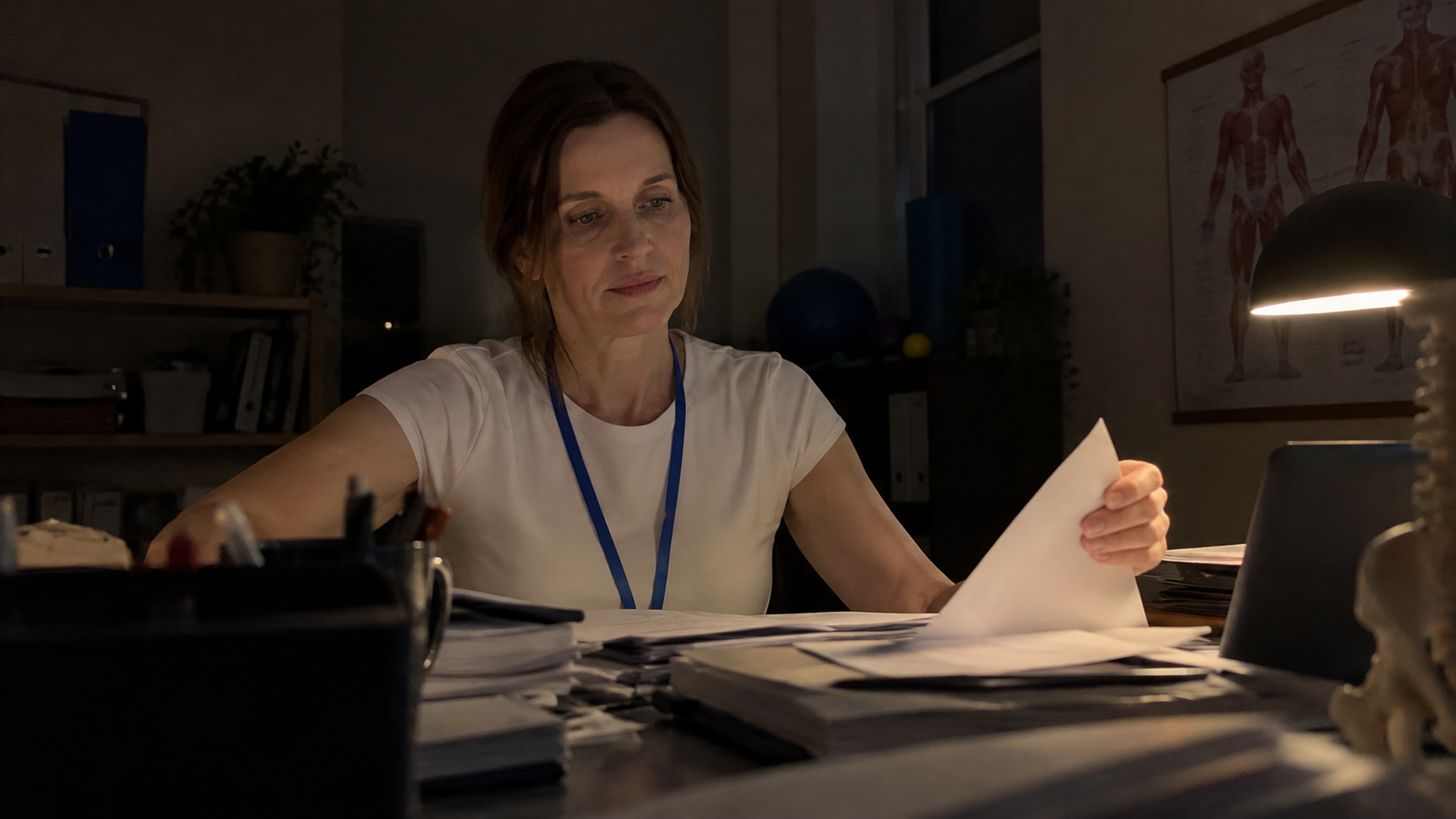
I spent the next five months looking into different workstation designs.
Most of what I found was disappointing.
Expensive ergonomic chairs. Standing desk accessories. Special cushions.
All promising a more comfortable position.
Then one day, I came across a demonstration that made me stop.
A person was working at a desk, adjusting the chair's backrest and seat to support their body in different ways.
They could sit, work more upright, or use the backrest for support.
And the entire time, they stayed at their computer.
I immediately thought about Rachel.
She'd spent years trying to adapt her body to her workstation.
What if her workstation could finally adapt to her?
But I wasn't ready to recommend another chair based on a demonstration.
Rachel had already spent enough money on products that disappointed her.
I wanted to see what would happen during a real eight-hour workday.
The 30-Day Test
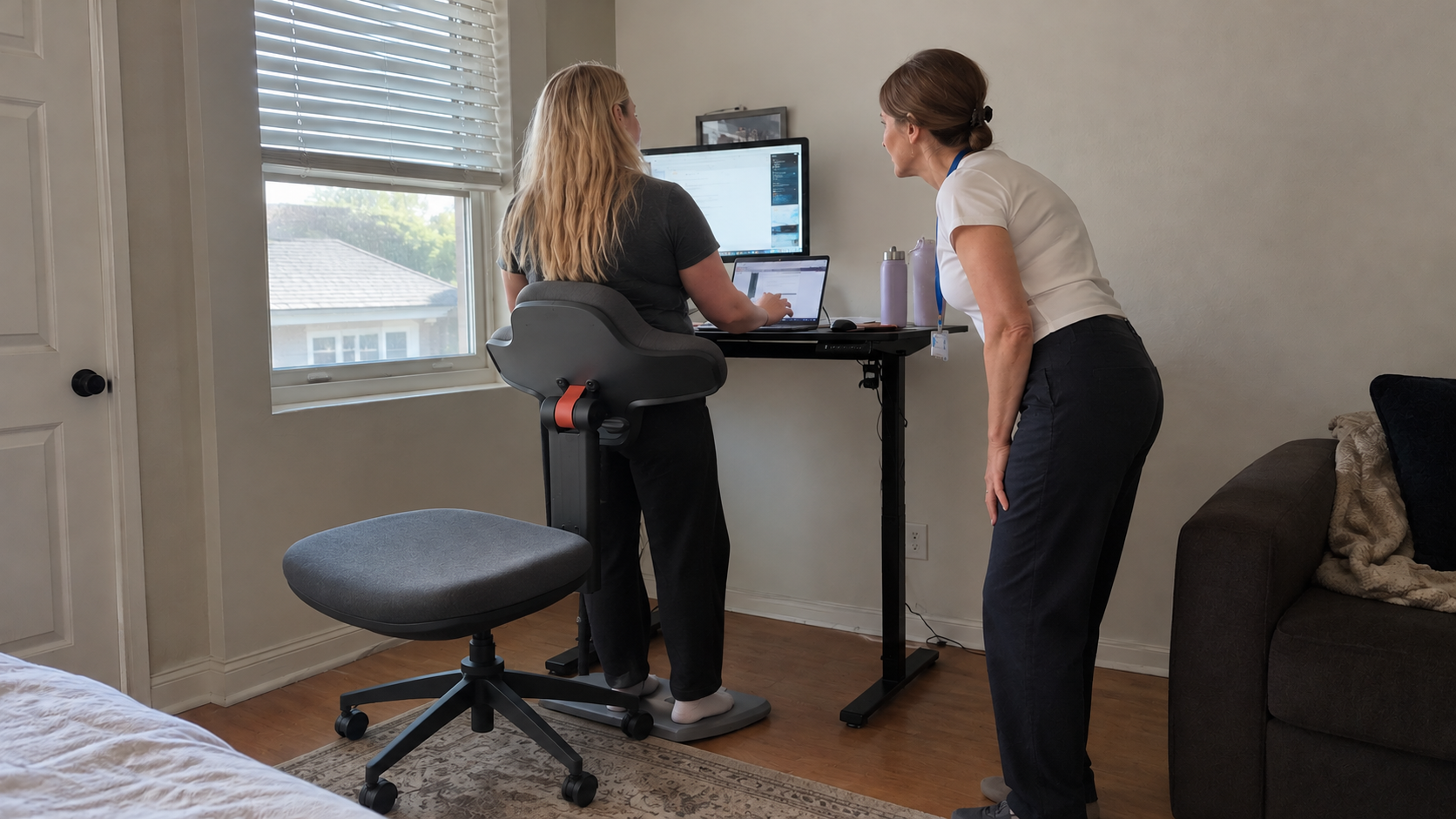
So we arranged for Rachel to try the chair for 30 days.
Not for a quick demonstration.
For real workdays. Meetings. Emails. Deadlines.
When I brought up the idea, she wasn't exactly excited.
"Another chair? Seriously?"
I couldn't blame her.
She'd already spent enough money on things that didn't work out.
But eventually, she agreed.
On one condition.
"If this is another mistake, I'm going to lose my mind."
Fair enough.
So we started the test.
And by the third week, something happened that neither of us expected.
The First Week Wasn't What She Expected
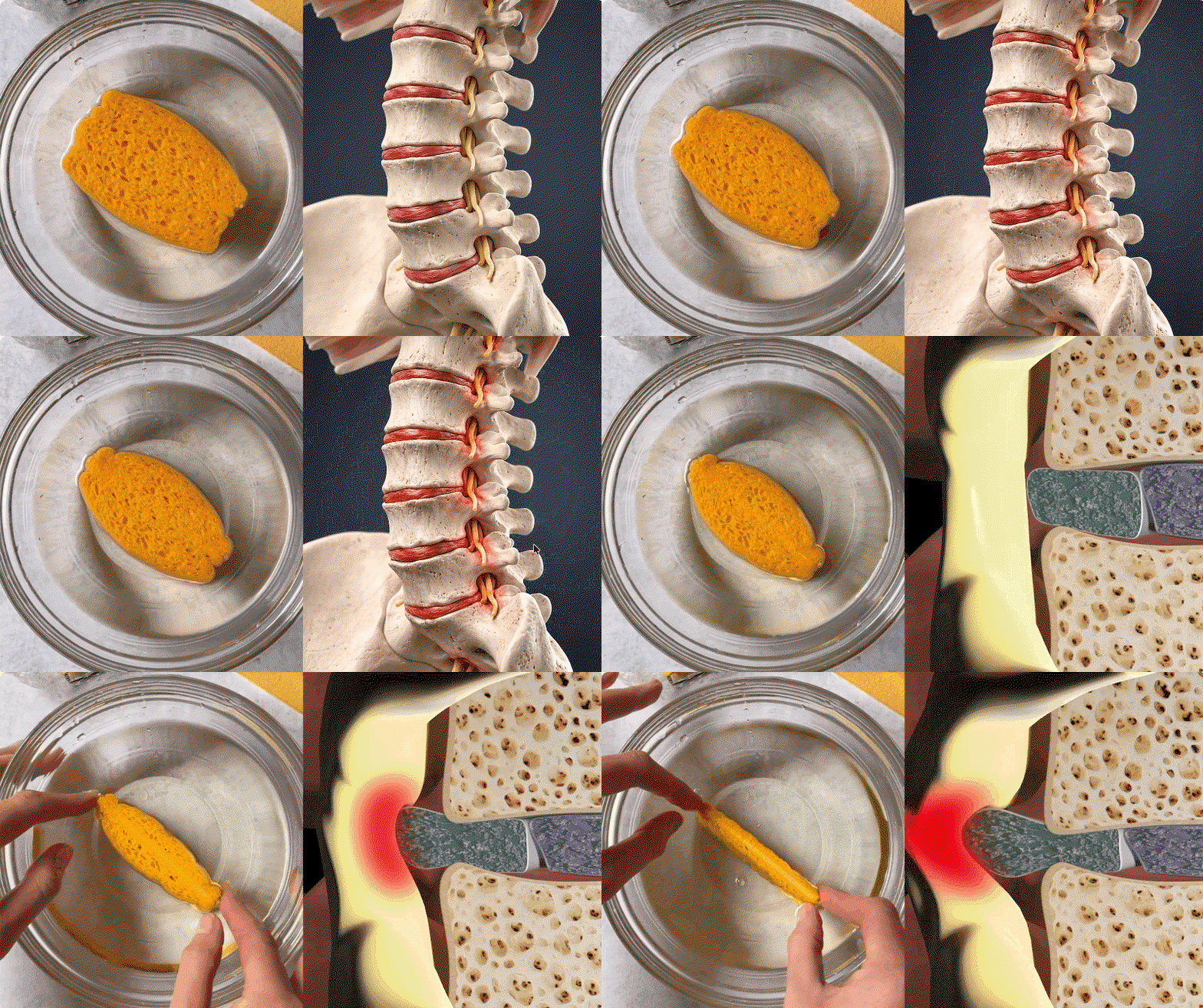
Rachel's first few days weren't some dramatic overnight transformation.
Honestly, she found the whole thing a little strange.
She was used to either sitting or standing.
Now she had to figure out how to adjust the backrest, set the seat height, and use the different types of support.
And at first, she kept making the same mistake.
She'd wait until the discomfort started before doing anything about it.
But after a few days, she began adjusting her setup earlier.
Sometimes between emails. Sometimes before a meeting.
"I used to think I had to find the right position and stay there," she told me.
"Now I'm starting to realize I don't have to stay in any of them."
By the end of that week, she noticed something.
She was spending less time thinking about how to escape her chair.
Her sciatica hadn't disappeared. She still had difficult moments.
But for the first time, she was beginning to feel more in control of her workday.
And the real test was still ahead.
The Meeting That Made Her Cry
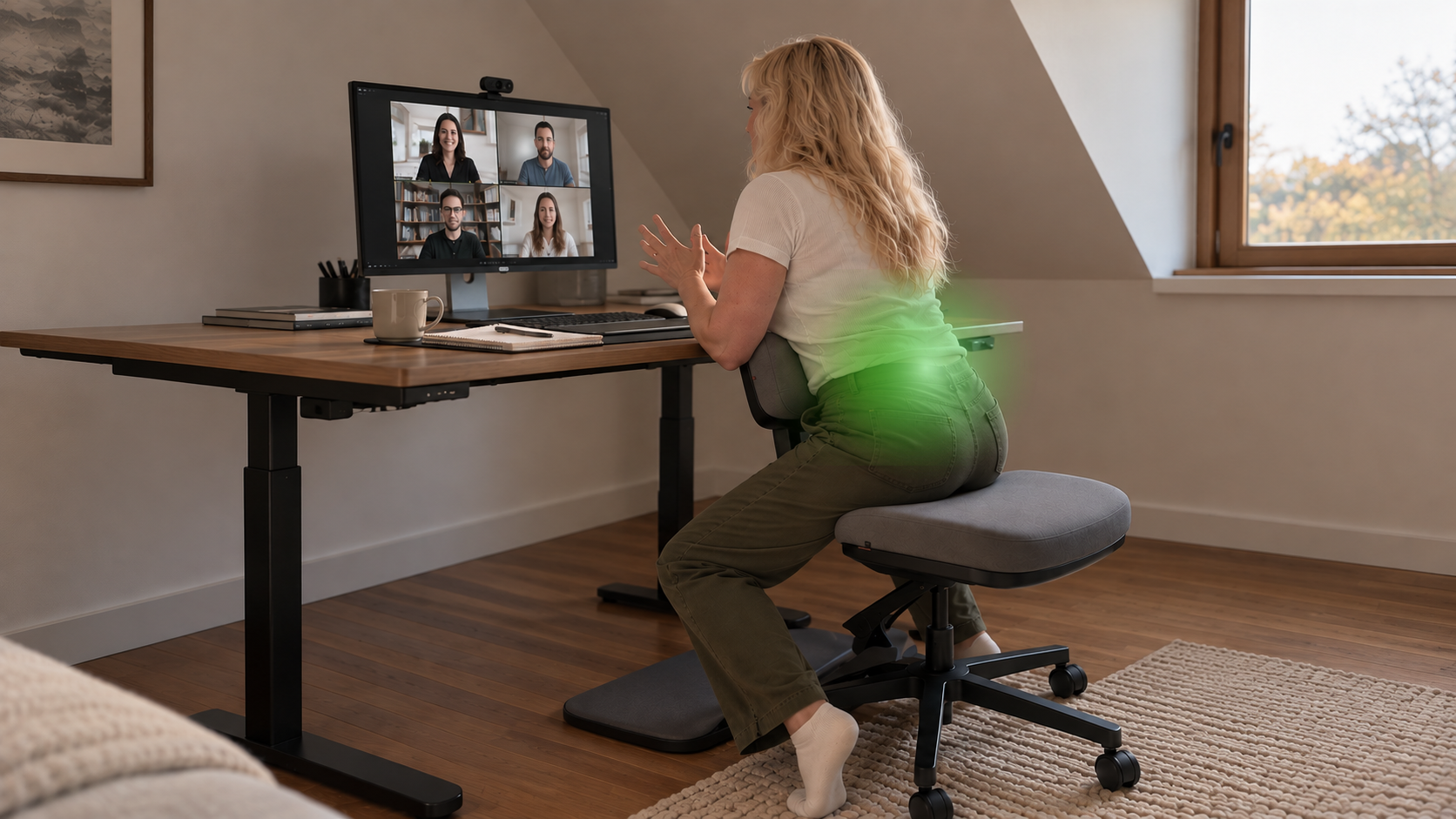
It happened during the third week.
Rachel had a long project meeting scheduled for Tuesday morning.
An important client.
Her manager.
Several members of her team.
Normally, she'd spend the first twenty minutes trying to sit still.
Then the burning would start.
She'd turn off her camera.
Stand up.
Stretch.
Sit back down.
And try to follow the conversation while searching for a position that didn't hurt.
But this time, she approached it differently.
She started the meeting sitting.
A little while later, she changed into another supported position.
Then another.
Her computer stayed right in front of her.
Her camera stayed on.
She kept listening.
Kept participating.
The meeting lasted almost an hour.
And for the first time in a long time, she got through it without having to leave her workstation to deal with her discomfort.
She'd changed positions several times.
But she hadn't lost track of the discussion.
She was just there.
Doing her job.
Afterward, she called me.
"I had a whole meeting with my camera on."
She went quiet.
Then she started crying.
Not because her pain had disappeared.
It hadn't.
She was crying because, for almost an hour, she'd been able to concentrate on her work instead of worrying about how she was going to get through it.
"I actually heard everything people were saying."
She laughed through her tears.
"That sounds so stupid, doesn't it?"
But it didn't sound stupid to me.
Not after hearing how scared she'd been about losing her job.
And then she said something I won't forget.
"For the first time in years, I felt like I could just do my job again."
Rachel hadn't been looking for another piece of office equipment.
She just wanted to get through a meeting without spending the whole time worrying about her back and leg.
And for the first time in a long time, she'd done exactly that.
What Happened By Day 30
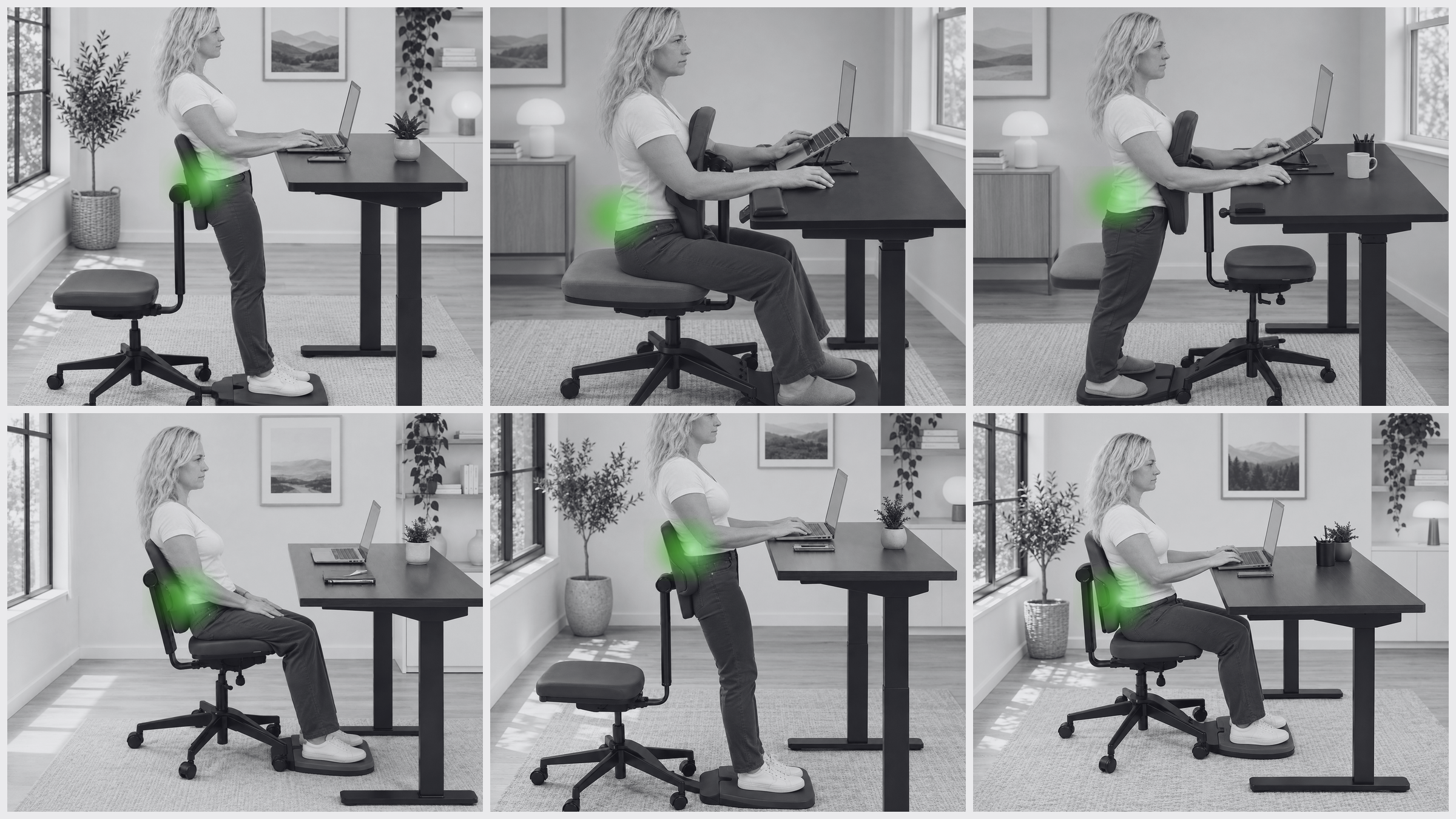
By day 30, Rachel's workday looked different.
She still had sciatica.
Still had difficult days.
And she continued following her medical treatment plan.
But she wasn't starting every meeting already worried about how she'd get through it.
She was asking questions again.
Following discussions.
Contributing in the way she used to.
And her manager noticed.
"He told me it was good to have me back."
Only a month earlier, she'd been terrified that same manager was questioning whether she could still do her job.
Now she was thinking about her next project.
She hadn't found a cure for sciatica.
She'd found a way to make her workday more manageable.
And for Rachel, that changed everything.
The Chair Behind the 6-Position Movement Method
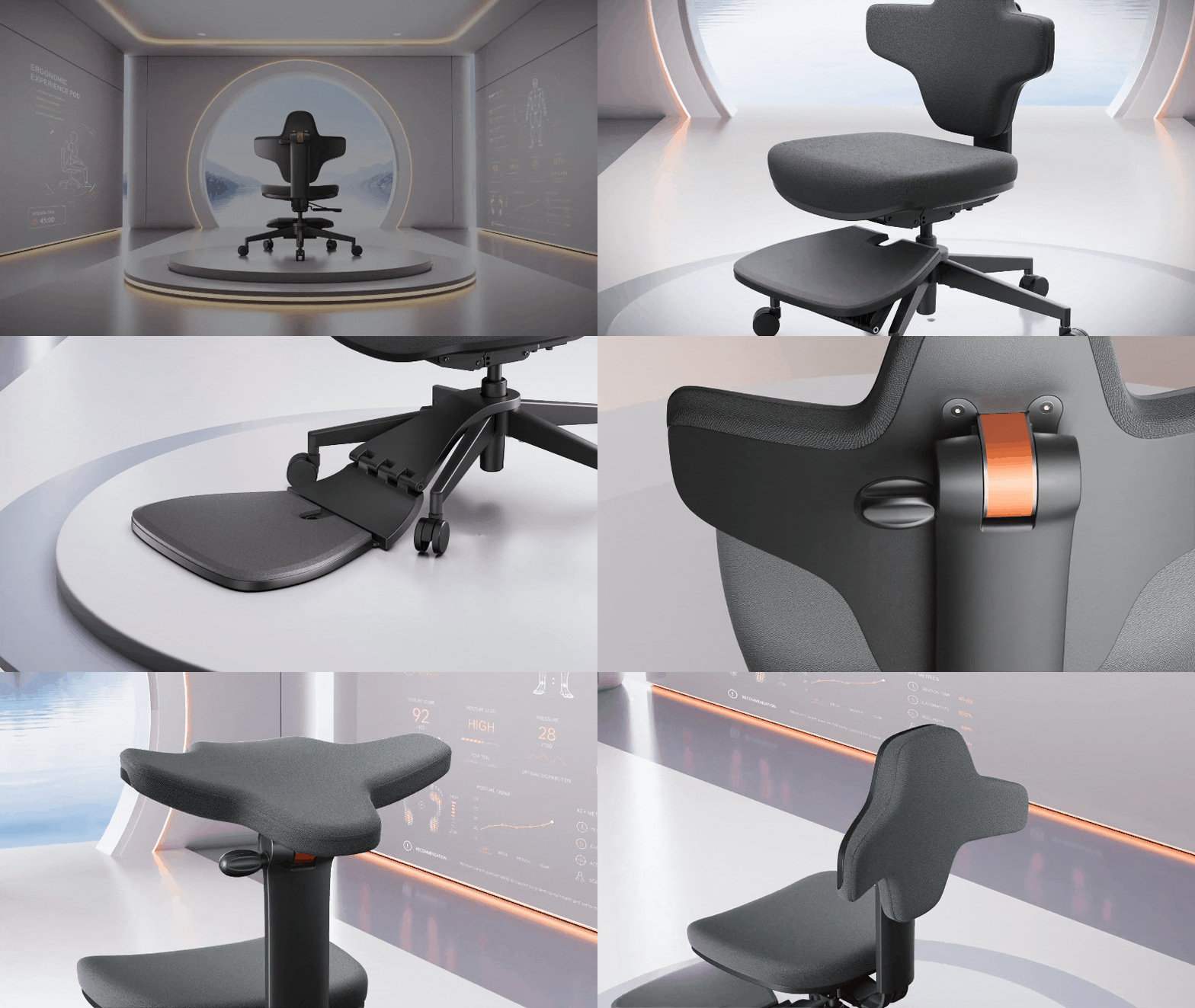
The chair Rachel tested is called STANT.
And here's what makes it different.
First, the adjustable backrest.
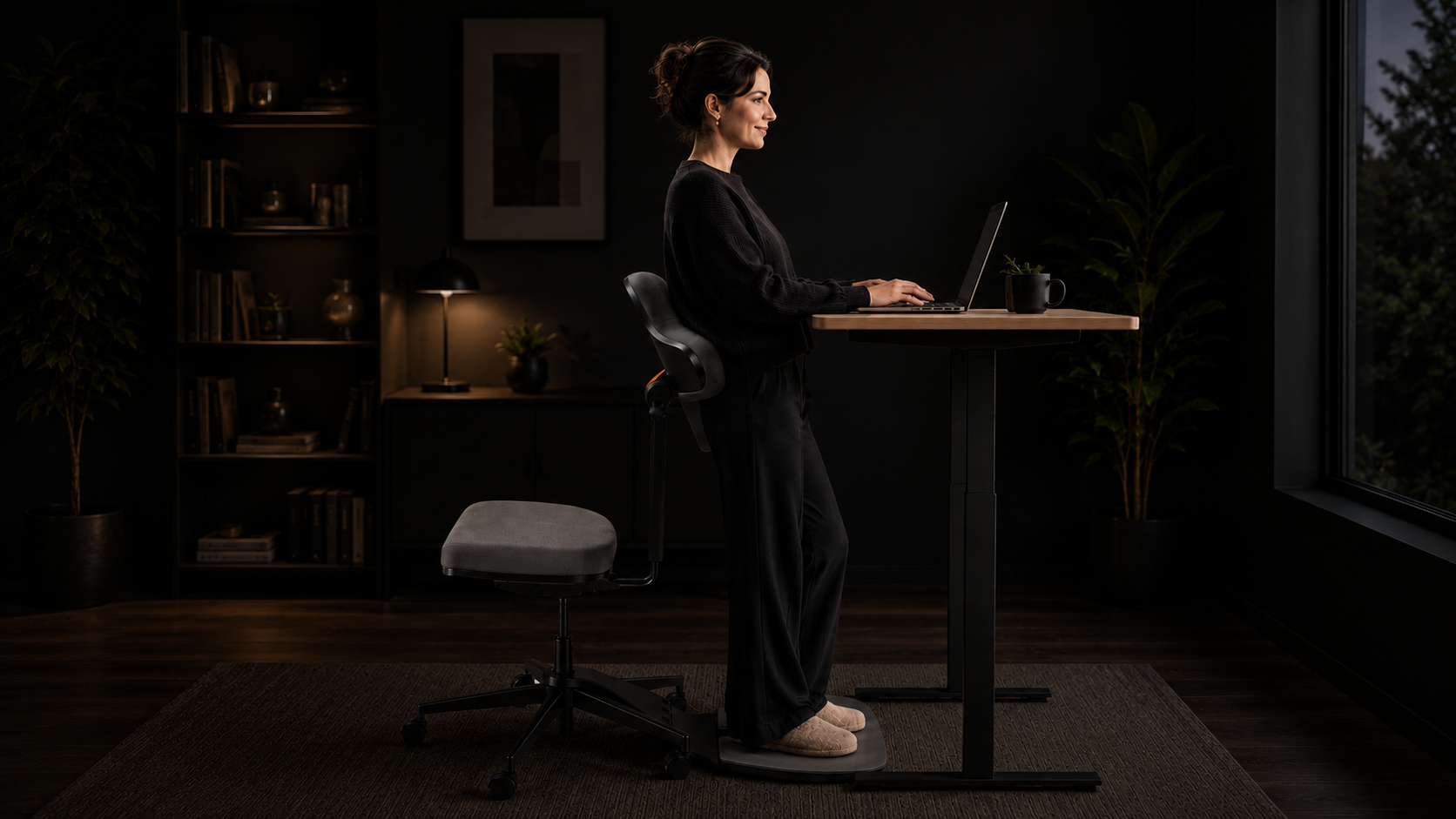
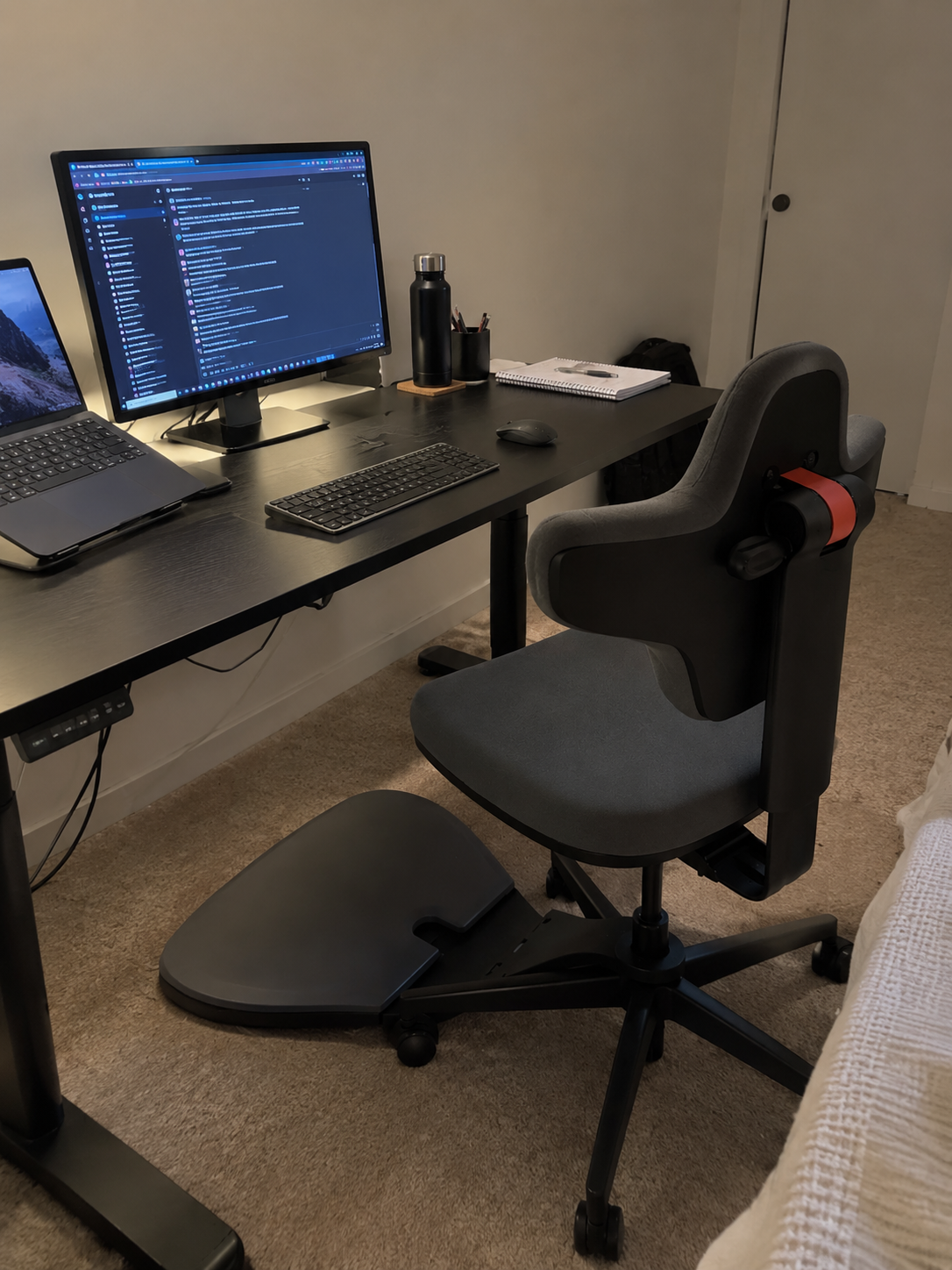
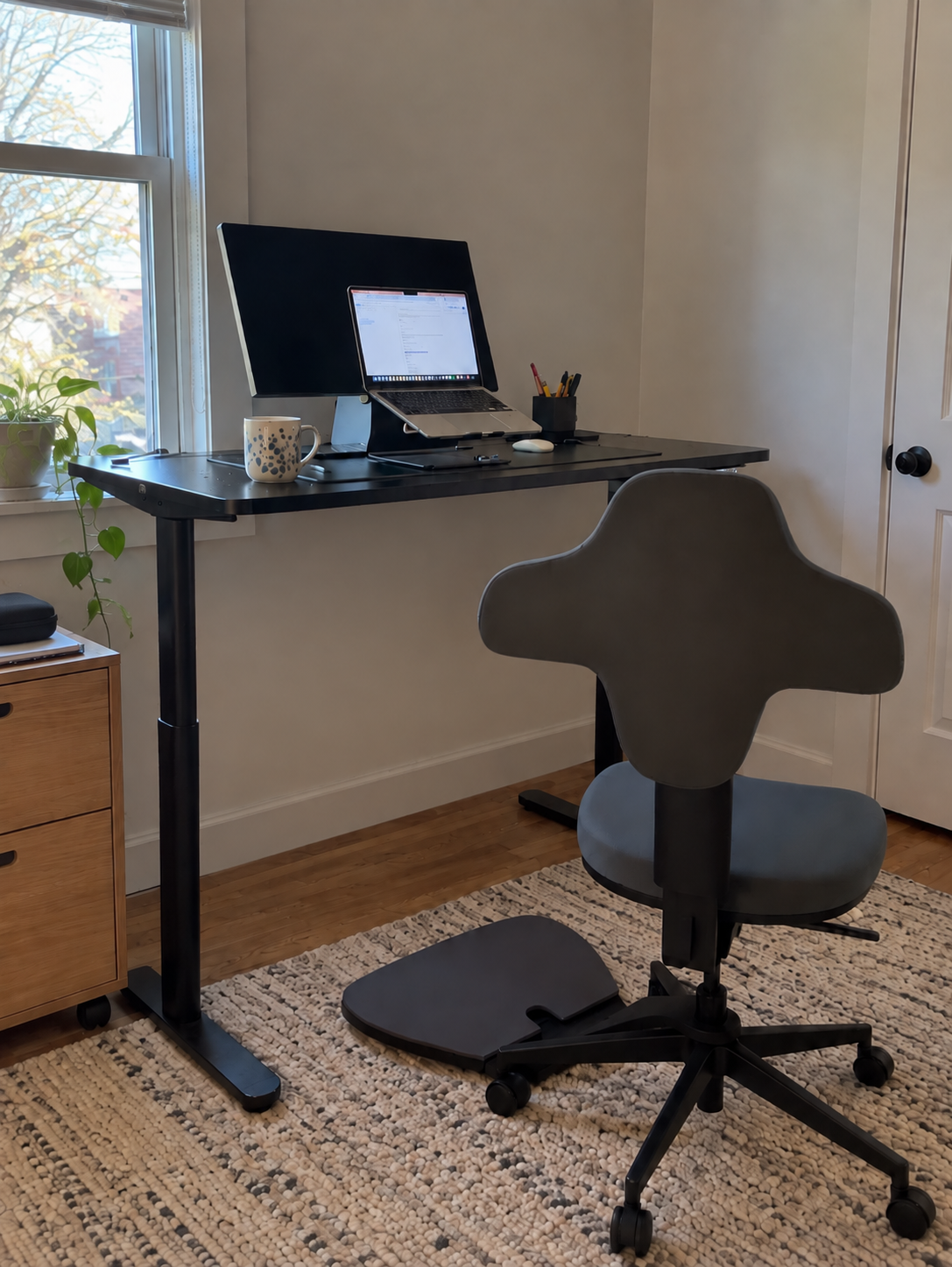
Unlike a conventional office chair, STANT's backrest can be repositioned to support your body in different working postures.
You can use it behind you, adjust it for a more upright setup, or position it in front of you for forward support.
Second, the adjustable seat height.
You can lower the seat for regular sitting or raise it for supported, more upright working positions.
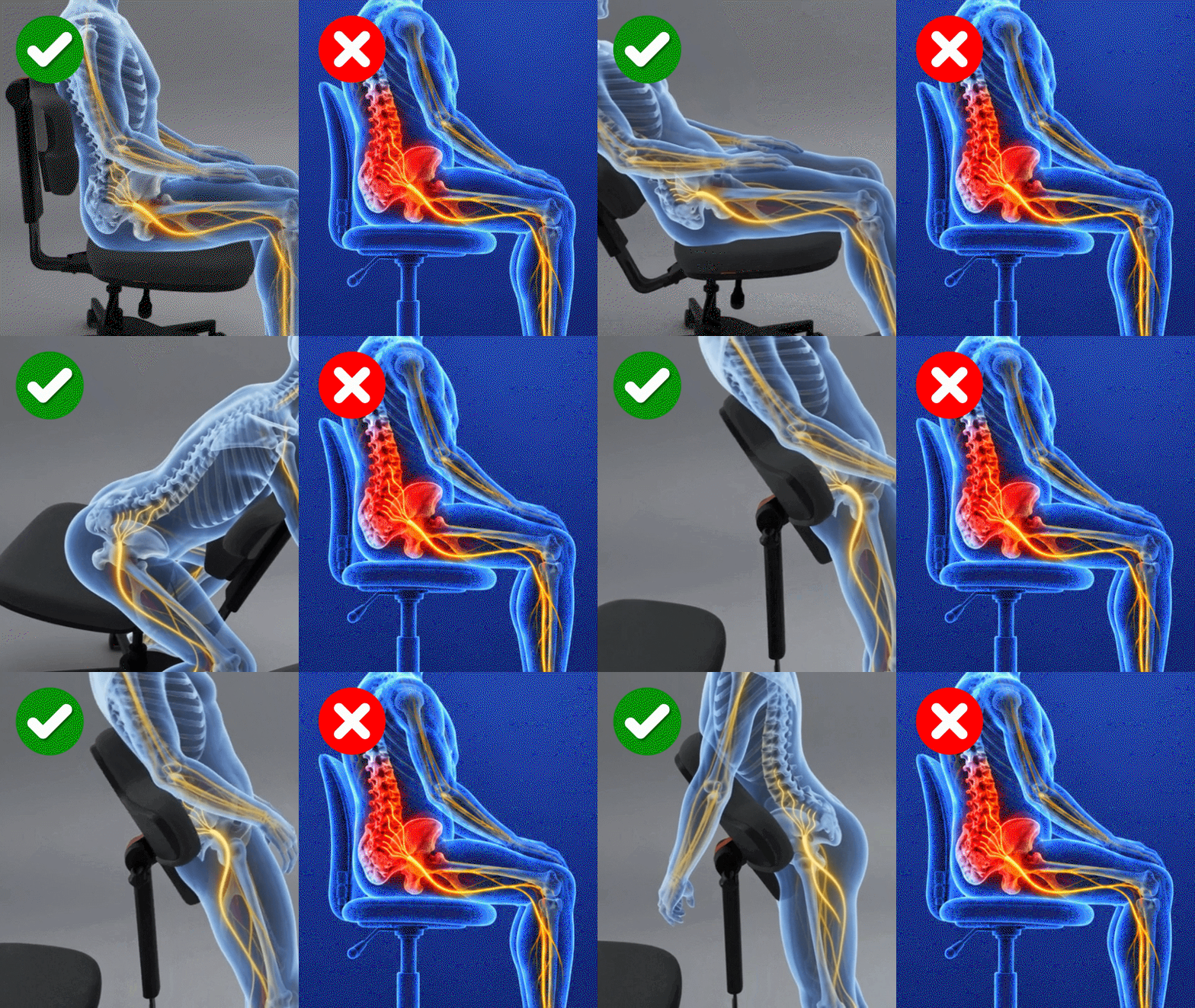
Together, the seat and backrest allow six different working positions:
Sitting. Perching. Leaning. Reclining. Straddling. Forward leaning.
Third, the built-in anti-fatigue standing mat.
When you're working upright, your feet rest on a cushioned surface rather than directly on the floor.
And when you're using a supported upright position, the chair can carry part of your body weight instead of leaving your legs to do all the work.
All three components work together in one adjustable setup.
No separate perching stool. No additional standing mat. No second chair.
That's what makes STANT different from another expensive ergonomic chair.
It doesn't just change how comfortable sitting feels.
It changes the ways you can work.
Medical note: STANT is an ergonomic workstation product, not a treatment or cure for sciatica. Responses to different working positions vary depending on the individual and underlying condition. Continue following your healthcare professional's advice.
Before You Spend Another $1,000 on an Ergonomic Chair…
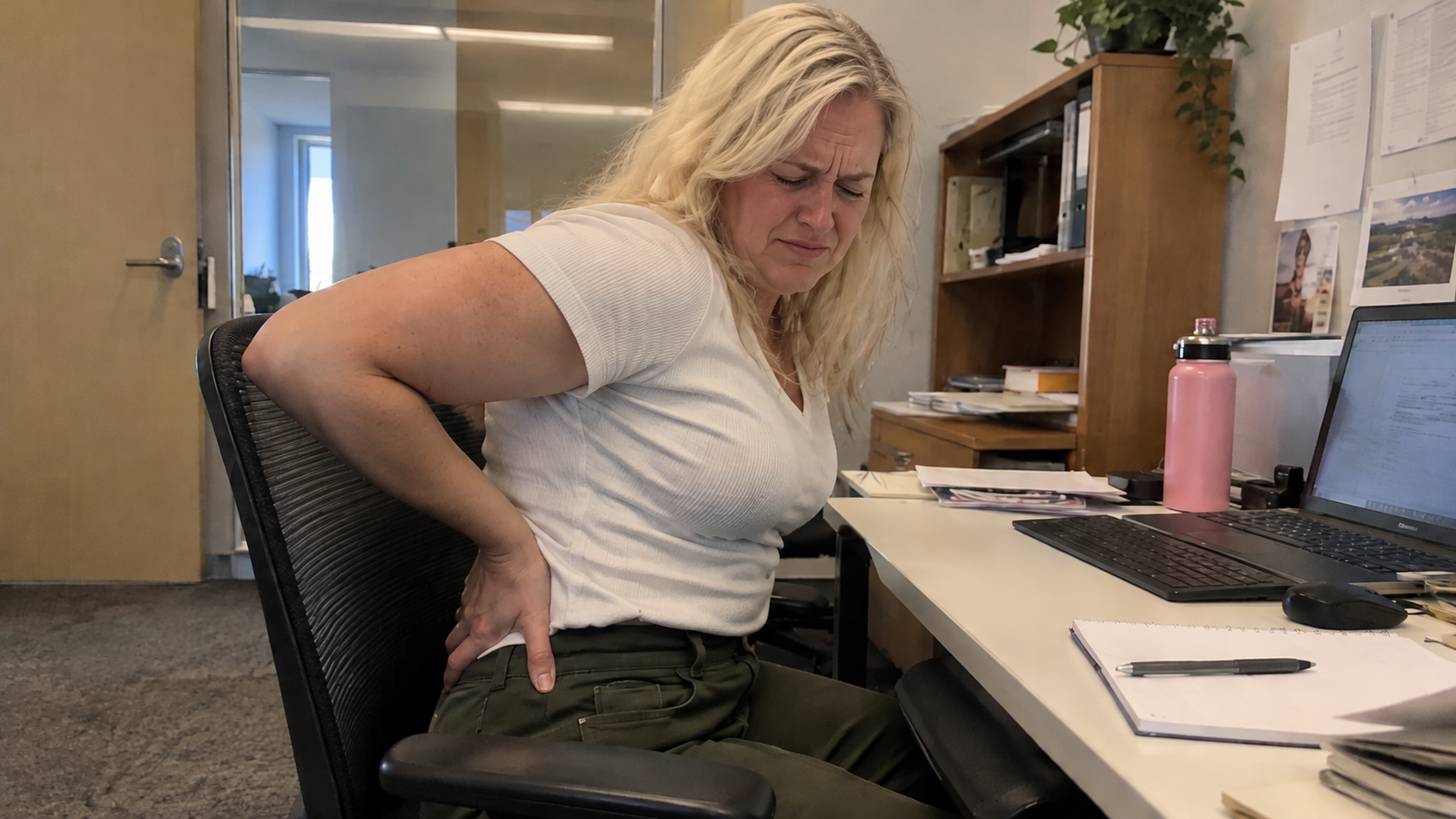
Think about how much you've already spent trying to get comfortable.
The cushions. The lumbar pillows. The expensive office chair.
Maybe even a standing desk.
And after all that, you're still counting down the minutes until you can get up.
Still wondering how you're supposed to do this for another ten or twenty years.
Because when you spend every day working around discomfort, it doesn't end when you close your laptop.
It follows you everywhere.
It affects your energy. Your concentration. Your confidence.
And eventually, the way you feel about your career.
So before spending another $1,000 on an ergonomic chair, I'd ask one question.
Will this actually change how I work, or just make sitting a little more comfortable?
The 6-Position Movement Method Is Now Available for $399
When Rachel told me she'd spent almost $900 on an ergonomic chair, I understood why she was hesitant to try anything else.
Nobody wants to spend that kind of money twice.
That's why I was interested to see that STANT is currently offered for $399, reduced from its regular listed price of $571.
And it includes the full six-position adjustable chair, with a built-in standing mat.
You also get free express shipping.
And a 2-year warranty against manufacturing defects.
But there's one more thing I think matters even more if you've already wasted money on chairs that disappointed you.
You Have 30 Days to See How It Fits Your Workday
You don't have to decide whether this approach is right for you after sitting in a chair for five minutes.
Use it in your actual workspace.
During your real meetings.
On the long afternoons when sitting starts to feel uncomfortable.
When you're answering emails, working on deadlines, or trying to concentrate through another full day.
Move between the six supported positions.
Find out how naturally they fit into your working routine.
And if STANT isn't the right fit, you can request a return within 30 days of delivery, under the return policy.
That's the part I particularly like.
Because after everything Rachel had spent trying to get comfortable, I wouldn't want someone else making another expensive decision without the chance to try the setup in their own home.
Free Express Shipping | 30-Day Returns | 2-Year Warranty
Returns are subject to the published return policy. Standard return shipping costs are the customer's responsibility.
The Choice I Wish Rachel Had Known About Four Years Earlier
Think about your next Monday morning.
You open your laptop.
Another day full of meetings, emails, and deadlines.
And before you've even started, you're already wondering how long you'll be able to sit.
Now imagine a different kind of workday.
One where your workstation gives you more ways to sit, work upright, and support your body.
Where getting comfortable doesn't always mean stepping away from your computer.
You're still at your desk.
Still in your meeting.
Still doing your job.
That's what Rachel had been missing.
And remember that meeting Rachel told me about?
The one where she finally heard everything people were saying?
Your next meeting could be the one where you finally get to focus on the conversation again.
You shouldn't have to wait until you're afraid of losing your job to reconsider a workstation that's making every day harder than it needs to be.
P.S.
Remember what Rachel said when she first described her problem?
"I can't sit. I can't stand all day. What the hell am I supposed to do?"
If you've ever asked yourself the same question, STANT is currently available for $399, with free express shipping and 30-day returns.
Customer Reviews
4.8 out of 5
3,791 customer ratings
5 Star
90%
4 Star
7%
3 Star
2%
2 Star
0%
1 Star
1%
By Feature
Price5.0
Effectiveness5.0
Comfort5.0
Quality4.8
Comments

Tessa Whitmore
The first time I finished a full Zoom meeting without having to turn my camera off and walk around I almost cried. Sounds dramatic but anyone dealing with sciatica and a desk job will understand.
Like · Reply · 4 · 39 min

Sloane Bennett
Absolutely loving this chair!!
Like · Reply · 4 · 22 min

Maren Caldwell
Not exaggerating when I say I was close to quitting my office job. Sitting hurt, standing got tiring, and nothing I bought seemed to help. I've been using this for about 6 weeks now. I still take breaks but I'm finally getting through my workdays without constantly fighting with my chair.
Like · Reply · 4 · 45 min

Nolan Pierce
Anyone here actually have sciatica and use this? I'm at the point where I can barely sit through a 30 min meeting.
Like · Reply · 4 · 1 hr

Brielle Dawson
I'm 35 and was seriously discussing surgery with my doctor because sitting at work had become unbearable. I tried PT, a standing desk, expensive chairs, literally everything. I've been using this chair for a month now and being able to change positions without leaving my desk has made working so much easier. Still have sciatica, but I'm not spending every meeting counting the minutes until I can stand up.
Like · Reply · 4 · 1 hr

Everett Hayes
I cant even believe to tell you the difference I feel in my day to day.
Like · Reply · 4 · 1 hr

Griffin Wells
Same here!
Like · Reply · 4 · 35 min

Isabella Mason
Just got mine today. I'm using it tonight for the first time. Fingers crossed!
Like · Reply · 4 · 4 hr

Frank Scheider
How long does it take to get to you?
Like · Reply · 4 · 3 h

Kelly Mercer
I just wanted to say thank you to whoever designed this chair. I spent almost 2 years dreading my desk job because of the burning down my right leg. Being able to move around while I work has made a real difference. I can finally focus on my actual job instead of constantly thinking about my back.
Like · Reply · 4 · 4 hr

Willa Prescott
I've had an L5-S1 herniated disc for years. My PT kept telling me to change positions more often but that's easier said than done when you work 8 hours at a computer. This chair actually makes that possible without getting up every 15 minutes.
Like · Reply · 4 · 5 hr

Paula Watson
Wow this sounds amazing.
Like · Reply · 4 · 6 hr

Delaney Brooks
Was skeptical about spending this much on another chair. Especially after my $800 ergonomic one did absolutely nothing for my sciatica. I've had STANT for 3 weeks and the leaning position is easily my favorite. Wish I'd found it sooner.
Like · Reply · 4 · 6 hr

Cassidy Monroe
I just ordered mine! Cannot wait for it.
Like · Reply · 4 · 6 hr

Reid Sullivan
I really want to test this out. My back has been killing me lately.
Like · Reply · 4 · 7 hr

Mia Barrett
Does anyone know how long shipping takes? I want to surprise my dad with one.
Like · Reply · 4 · 7 hr

Graham Ellis
Hey Mia, mine arrived after about a week.
Like · Reply · 4 · 6 hr
MEDICAL & HEALTH DISCLAIMER: The information and other content provided in this page, or in any linked materials, are not intended and should not be construed as medical advice, nor is the information a substitute for professional medical expertise or treatment.
THIS IS AN ADVERTISEMENT AND NOT AN ACTUAL NEWS ARTICLE, BLOG, OR CONSUMER PROTECTION UPDATE
HEALTH DISCLAIMER: The information on this website is for educational purposes only and is not intended to replace professional medical advice, diagnosis, or treatment. STANT is an ergonomic chair designed to support movement and different working positions. It is not intended to diagnose, treat, cure, or prevent sciatica or any other medical condition. Individual results may vary. Always consult a qualified healthcare professional regarding medical concerns or treatment decisions.